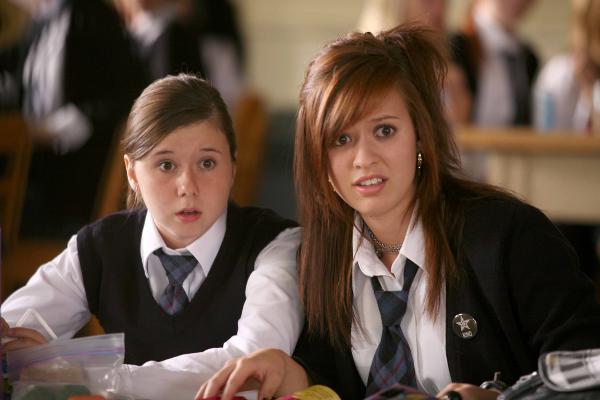
Journal d’Aurélie Laflamme, Le – Film de Christian Laurence

Le Journal d’Aurélie Laflamme est une comédie pour adolescents dont le personnage principal est tiré de la populaire série de livres écrits par l’auteure India Desjardins.

Le journal d’Aurélie Laflamme de Christian Laurence

Le journal d’Aurélie Laflamme de Christian Laurence

Le Journal d’Aurélie Laflamme est une comédie pour adolescents dont le personnage principal est tiré de la populaire série de livres écrits par l’auteure India Desjardins. Ce film est basé sur le premier tome de la série « Aurélie Laflamme, Extraterrestre ou presque ». Le réalisateur Christian Laurence vient du domaine de la télévision et signe ici son premier long-métrage de cinéma.

Comme on pouvait s’en douter d’après les succès obtenus par les livres, Le Journal d’Aurélie Laflamme fut reçu chaleureusement par le jeune public québécois qui en fit l’un des succès au box office de 2010. Au niveau international, le film de Christian Laurence eut droit à quelques sélections dans les festivals francophones, sans toutefois se démarquer outre mesure.

Un second film tiré des aventures d’Aurélie Laflamme a été produit par la suite.

Résumé

Aurélie est une adolescente de 14 ans, un peu perdue et donc en quête de solutions. Entre les habitudes de sa mère sédentaire et les chicanes avec sa meilleure amie, elle rêve à son premier french kiss ! Mais au fond, Aurélie se sent bien seule dans l'’univers, surtout depuis la mort de son père, il ya 5 ans.

Et si son père était simplement un extraterrestre, ayant quitté la Terre pour rejoindre sa planète? Génétique oblige, Aurélie serait elle-même une extraterrestre! Ceci expliquerait bien des choses. Par exemple, pourquoi elle se sent si différente des autres (surtout de sa mère), pourquoi elle n'’est pas capable d’'enligner deux mots sans faire une gaffe, et surtout pourquoi les garçons lui tapent vraiment sur les nerfs.

Synopsis officiel

Distribution

Marianne Verville (Aurélie Laflamme) ; Geneviève Chartrand (Kat) ; Aliocha Schneider (Nicolas) ; Jérémie Essiambre (Truch) ; Edith Cochrane (mère d’Aurélie) ; Pierre Gendron (Denis Beaulieu) ; Valérie Blais (Marie-Claude) ; Sylvie Potvin (Soeur Rose)

Fiche technique

Genre: Comédie dramatique - Origine: Québec, 2009 - Sortie en salles: 23 avril 2010 dans 83 salles au Québec - Durée: 1h48 - Classement: Général - Tournage: septembre-octobre 2009 - Budget approximatif: 4,1 M$

Réalisation : Christian Laurence - Scénario : Christian Laurence et India Desjardins, d'après le roman éponyme d'India Desjardins - Production : Claude Veillet et Lucie Veillet - Société de production : Films Vision 4 - Distribution : TVA Films

Équipe technique - Costumes : Julie-Anne Tremblay - Direction artistique : Marc Ricard - Montage : Hubert Hayaud - Musique : Martin Léon - Photographie : Geneviève Perron

Neighbors began to notice: a window that opened on schedule, a porch lamp that dimmed itself when the moon rose high, a tiny robot that carried fresh coffee across a kitchen counter with ceremonial care. They asked for advice, and Jonah showed them the headers and jumpers like revealing secret handshakes. He never explained the entire thing at once; mysteries coaxed companionship.

One Sunday a child from down the street pressed her forehead to the Plexiglas casing of Jonah’s prototype and asked, “Does it dream?” He smiled and spoke in the soft, precise way programmers do: “It keeps a very small kind of promise.” Then he taught her to solder a header and to be patient while a sketch compiled. Her laugh was a tiny confirmation — the shield had become an instrument of apprenticeship.

At first it seemed shy. A single servo whispered to life, sweeping like a gull testing wind. A temperature sensor, tiny as a fingernail, sent numbers tumbling back — shy, precise, alive. Jonah fed it commands the way one might read a bedtime story, each line of code another sentence spun from copper and intent. The shield listened, translating his punctuation into motion.

In some nights, when the workshop lights dimmed and the moon was a thin coin in the sky, Jonah swore he could hear a soft, almost inaudible hum — as if the shield were humming a tune of its own. Perhaps it was only the fan, or the distant rush of rain. Or perhaps, in the way that tools sometimes keep the echo of every hand that worked them, it remembered the voices it had answered and kept a tiny, faithful tune: ready, connected, alive.

Years later the little green board was scuffed and labeled in Jonah’s workshop, its silkscreen half-worn by fingers that had learned to measure resistance and wonder in equal parts. It had outlived several prototypes and sparked a dozen other projects. When he finally hung it on the wall, alongside a collage of schematics and faded resistor charts, it did not feel like a relic. It felt like the first page of a long book still being written — a promise that circuits could translate human stubbornness into small, persistent motion.

Night after night, his desk became a small, blinking parliament. Ultrasonic echoes turned into measured steps; light sensors learned the cadence of dusk; a mole of wires rearranged and rearranged until the air smelled faintly of solder and possibility. When a rainstorm took the neighborhood power one autumn evening, the shield did not complain — it simply shifted, drawing from the battery bank like an old dog finding a new patch of sun.